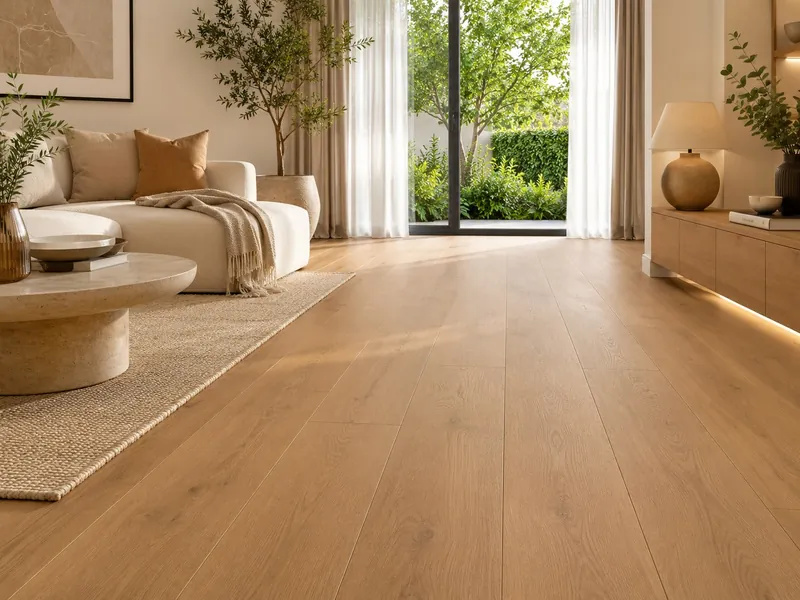
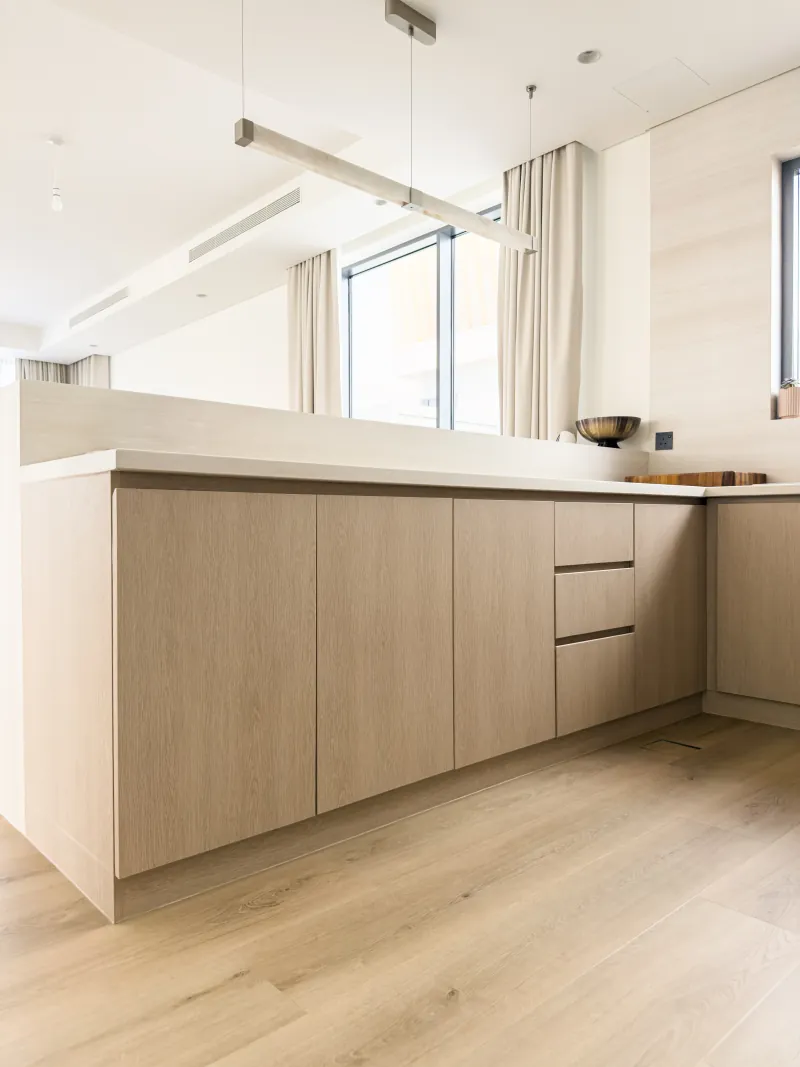
Wooden flooring in Dubai: real timber, or the wood look?
For wooden flooring in Dubai, I'd fit a wood-look plank in most rooms. Real timber moves with the air, and its warranty claims stopped us selling it.
By Stephen Pickering
For wooden flooring in Dubai, I'd fit a wood-look SPC plank in most rooms, and keep real timber for dry rooms where the air holds steady all year. If you do buy real wood, buy engineered, not solid. A solid board swells and shrinks with the air around it, and a Dubai home gives it plenty to react to.
Solid oak was on our first price list at The FloorHaus. Eighteen months later the warranty claims had taken it off. We've since dropped engineered wood too, so we don't sell timber of any kind. You're hearing this from someone with no wood to push.
What counts as wooden flooring in Dubai?
Six different floors get quoted under that name here, and only two of them have real wood on top. Find out which one you're being offered before you compare prices.
| On the quote | What it is | Real wood on top? | From us |
|---|---|---|---|
| Solid wood | One piece of timber, top to bottom | Yes | No |
| Engineered wood | A real wood layer glued to a core of crossed plies | Yes | No |
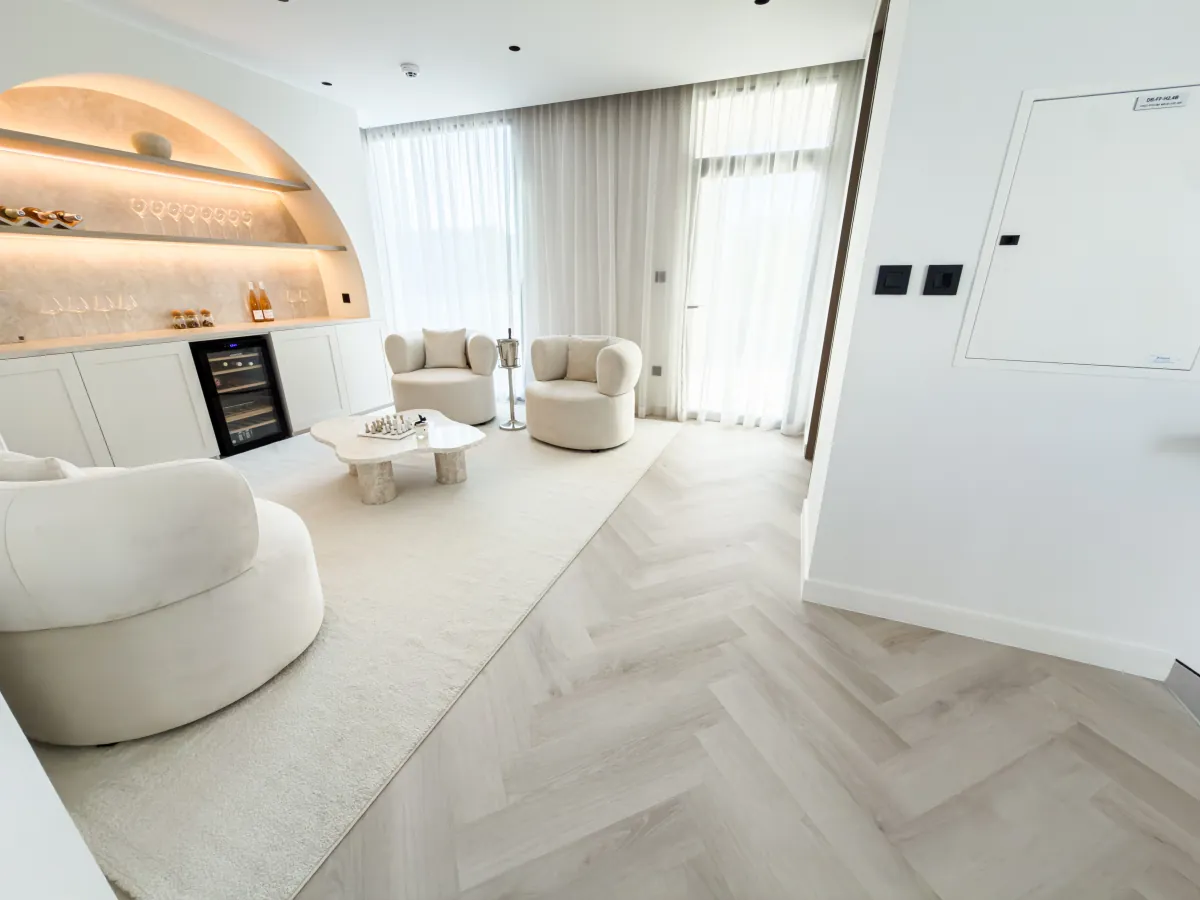
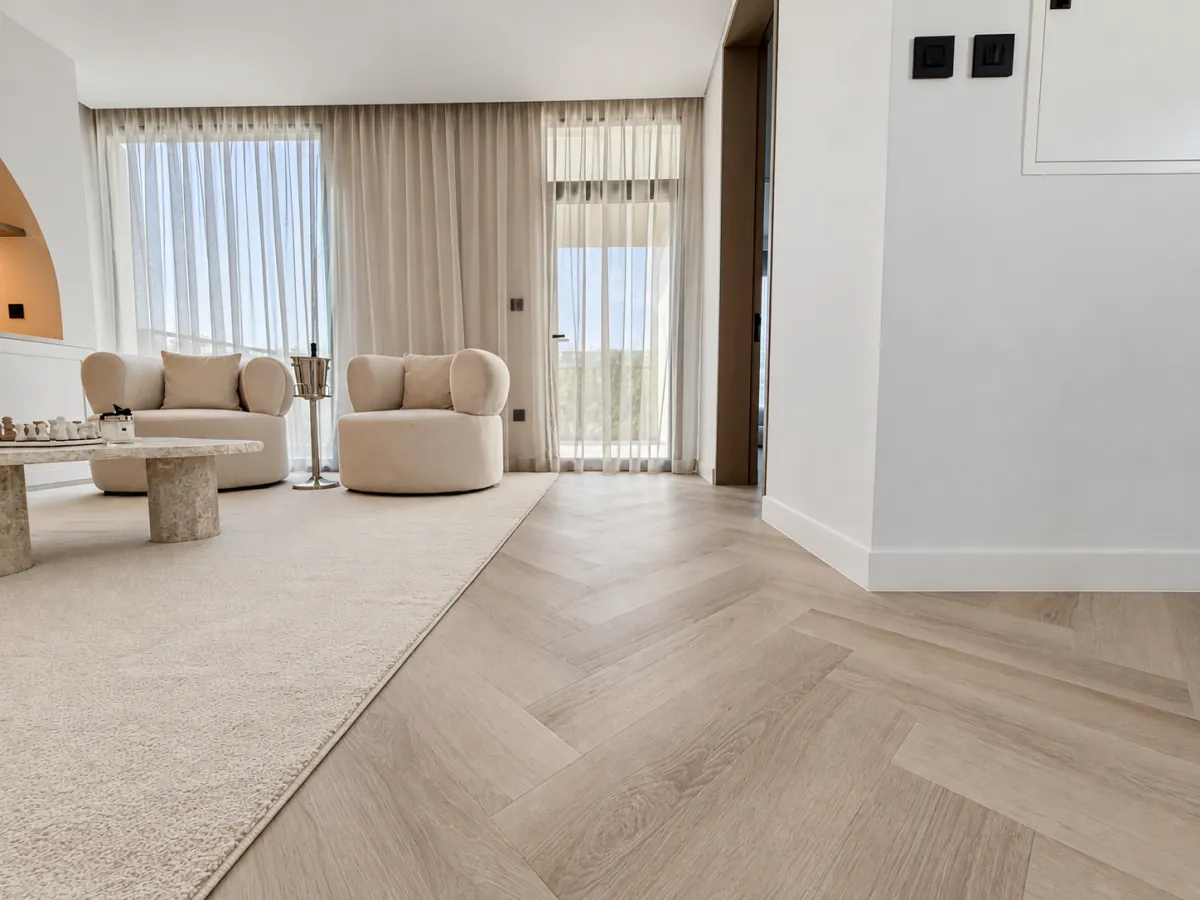
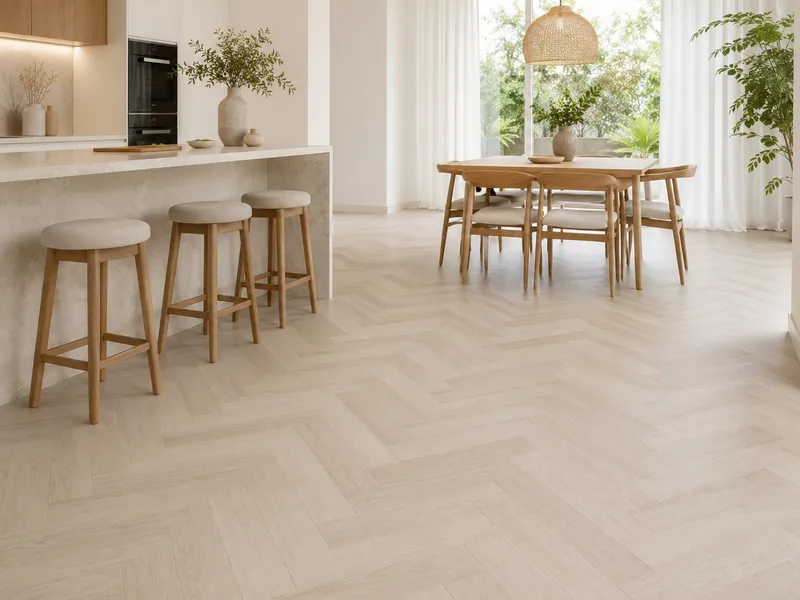
| Parquet | Blocks laid in a pattern, in any of these materials | Depends | Herringbone, in SPC |
| Laminate | A printed wood picture on compressed wood fibre | No | No |
| SPC | A printed wood picture on a rigid limestone and PVC core | No | Yes |
| LVT | A printed wood picture on a flexible vinyl core | No | Yes |
"Hardwood" covers the first two. Oak is a hardwood, and the US Forest Products Laboratory files it there in its Wood Handbook, chapter 4. So hardwood flooring in Dubai can mean solid oak or engineered oak, and a quote that only says "hardwood" hasn't told you which.
Laminate is made from wood, of a sort. Its core is wood "fibers that have been compressed under intense heat and pressure", says the North American Laminate Flooring Association (NALFA). It'll do in a dry bedroom, and laminate vs SPC shows where it won't. Parquet is a pattern rather than a material, and parquet flooring in Dubai takes the blocks and the patterns one at a time.
SPC and LVT both belong to the vinyl family, which vinyl flooring in Dubai explains type by type. Here they matter for one reason: they give you the wood look without the wood.
Does wooden flooring work in a Dubai home?
Real wood works where the air stays steady. That's rarer here than you'd think.
Wood soaks up moisture when the air's damp and lets it go when the air's dry. It swells and shrinks as it does.
The humidity decides how much it holds. Keep a room at 21°C and 40% relative humidity, and the wood in it ends up at roughly 8% moisture. Raise the humidity to 65% and it climbs to about 12% (Wood Handbook, chapter 4, table 4-2).
Along the grain, you'd barely see it. Most woods shrink only 0.1% to 0.2% that way, from green to oven-dry. Across the grain, it's a different story.
The Handbook gives fitters a sum for that. Take a flat-sawn white oak board 180 mm wide and move it from 8% to 12% moisture. It grows by about 2.7 mm (Wood Handbook, chapter 13, table 13-5).
The Handbook admits the sum probably runs high for boards that aren't perfectly flat-sawn. Call 2.7 mm the top of the range. A 4 m room still holds 22 of those boards, all doing it together.
Something has to give. The edges cup, the joints open, and in the end a board splits.
So the question is what your rooms do to the air. The same chapter names four things that set indoor humidity: moisture sources, ventilation, dehumidification such as air conditioning, and the humidity outside. In air-conditioned buildings, it says, conditions "depend largely on the proper sizing of the air-conditioning equipment".
A wooden floor in a Dubai villa is partly in the hands of whoever sized the AC.
The makers set the band your room has to stay in. Kährs, the Swedish maker, wants 30% to 60% relative humidity before, during and after fitting (Kährs, how to install wood floors). Junckers, which makes solid oak floors in Denmark, guarantees its boards within 35% to 65%. It says many engineered makers only allow a band 20 points wide (Junckers, solid vs engineered FAQ).
Now think about the stretch by the pool door in August. Then think about the guest room, with the AC off while you're away for the summer. Can't say both stay inside the band? Then timber's a gamble.
Why did we stop selling solid oak?
The same faults kept coming back under warranty: cupped boards, open gaps and splits. One claim can be bad luck. A run of them with the same three faults is a pattern.
We'd rather lose a sale than fit the same floor twice.
So we stopped, inside 18 months of opening. We moved to engineered oak, a 4 mm oak top layer on a core of birch and pine plies. Later we dropped that as well. Our floors now are SPC and LVT, and that's all.
Engineered wood vs solid wood: which moves less?
Engineered, by a distance. An engineered plank puts real wood on top of a stack of thin plies, each laid with its grain at right angles to its neighbour's.
That's the trick. Wood hardly moves along its grain, so every layer pins the ones touching it, and the plank stays put. Plywood's made the same way.
The point, in Kährs's own words, is "minimizing wood's natural movement through seasonal changes" (Kährs, FAQ about flooring). Note the word: minimising, not stopping. It's still timber, and Kährs still asks for that 30% to 60% band.
What solid wood keeps is sanding. Junckers says its solid boards can be sanded eight to ten times. Kährs says its engineered floors can take up to four sandings, depending on how thick the top layer is. On an engineered plank, that top layer is the only wood you'll ever sand, so ask for it in millimetres.
Ten sandings sound better than four. You'll only miss the other six if you'd have used them. In a Dubai home, I'd give them up for a floor that holds flat in between.
What does a wood-look floor give you instead?
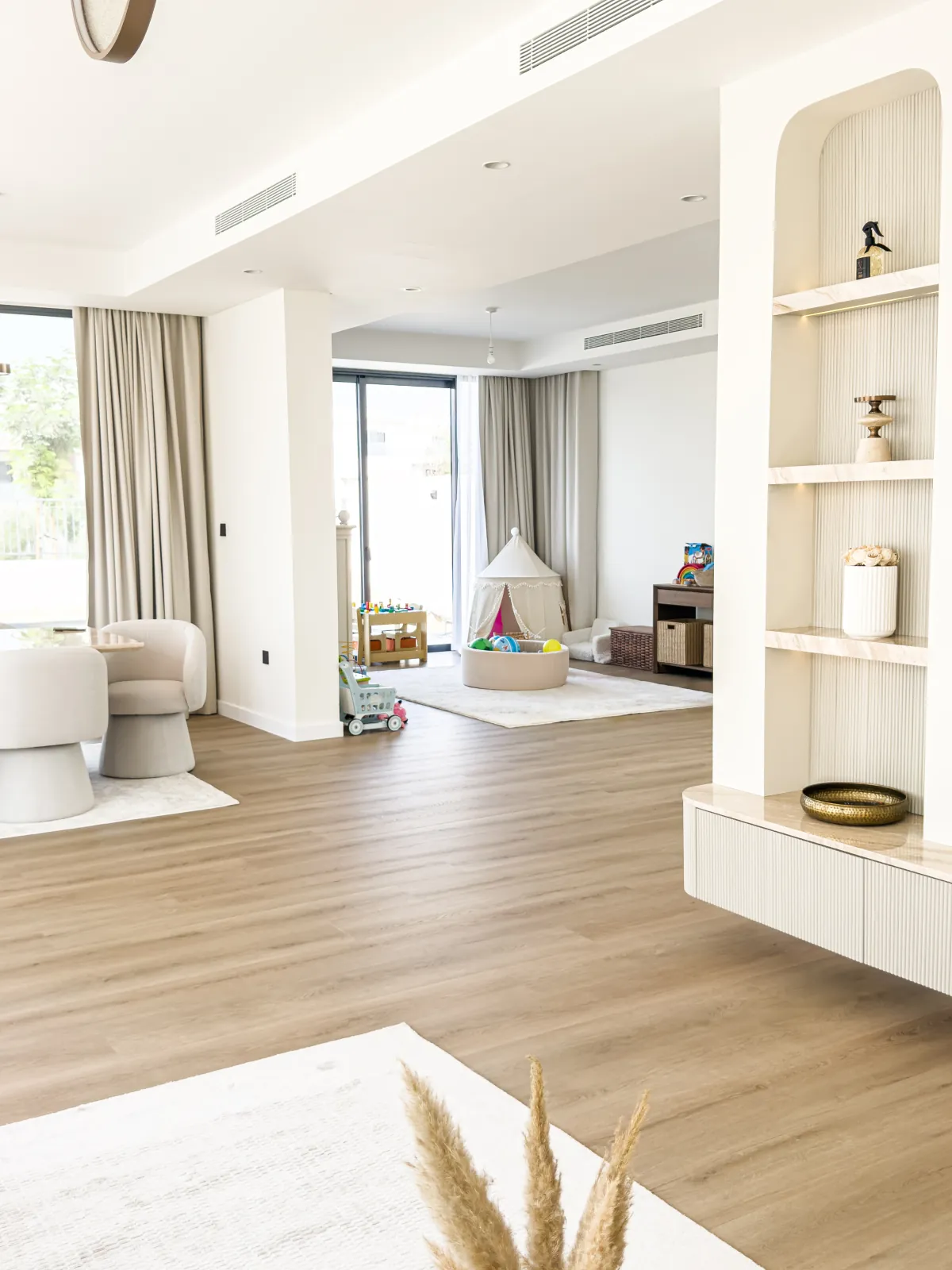
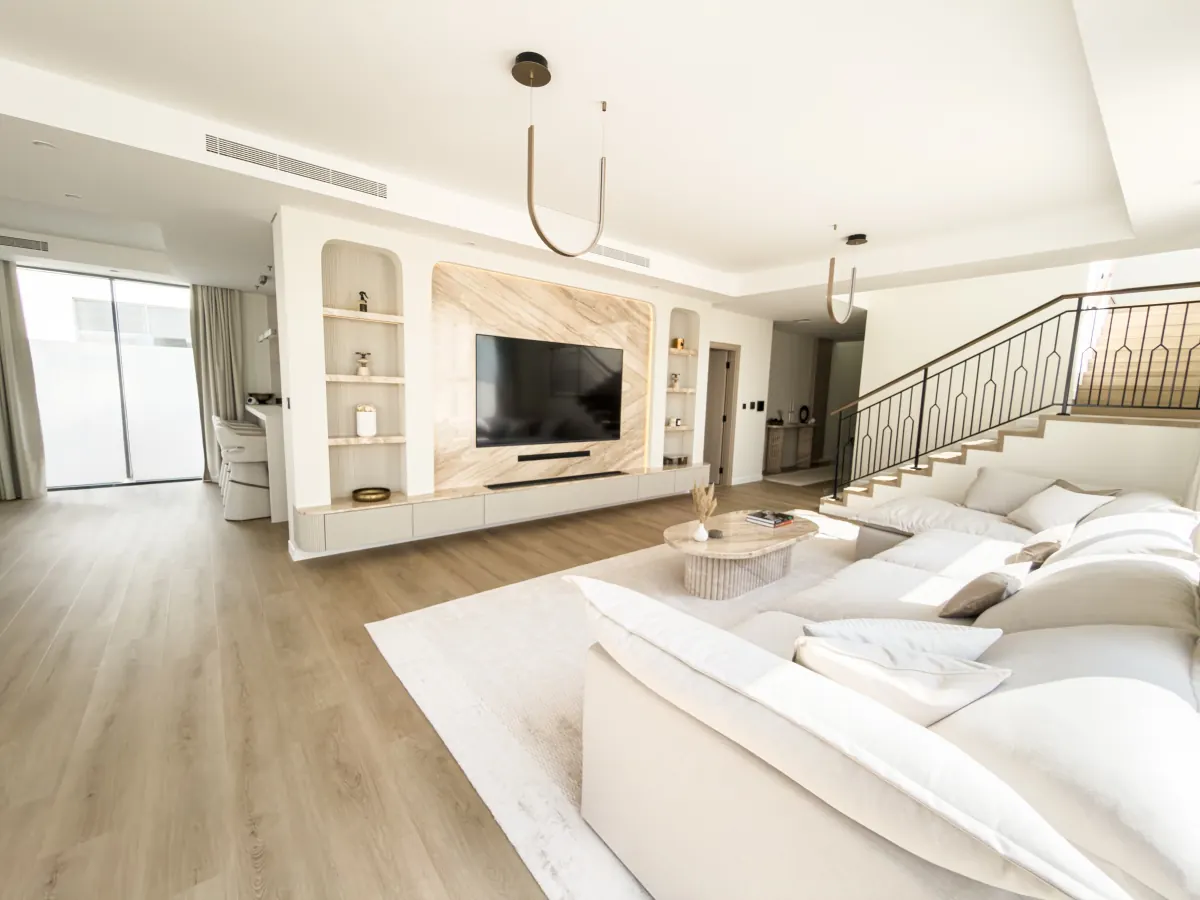
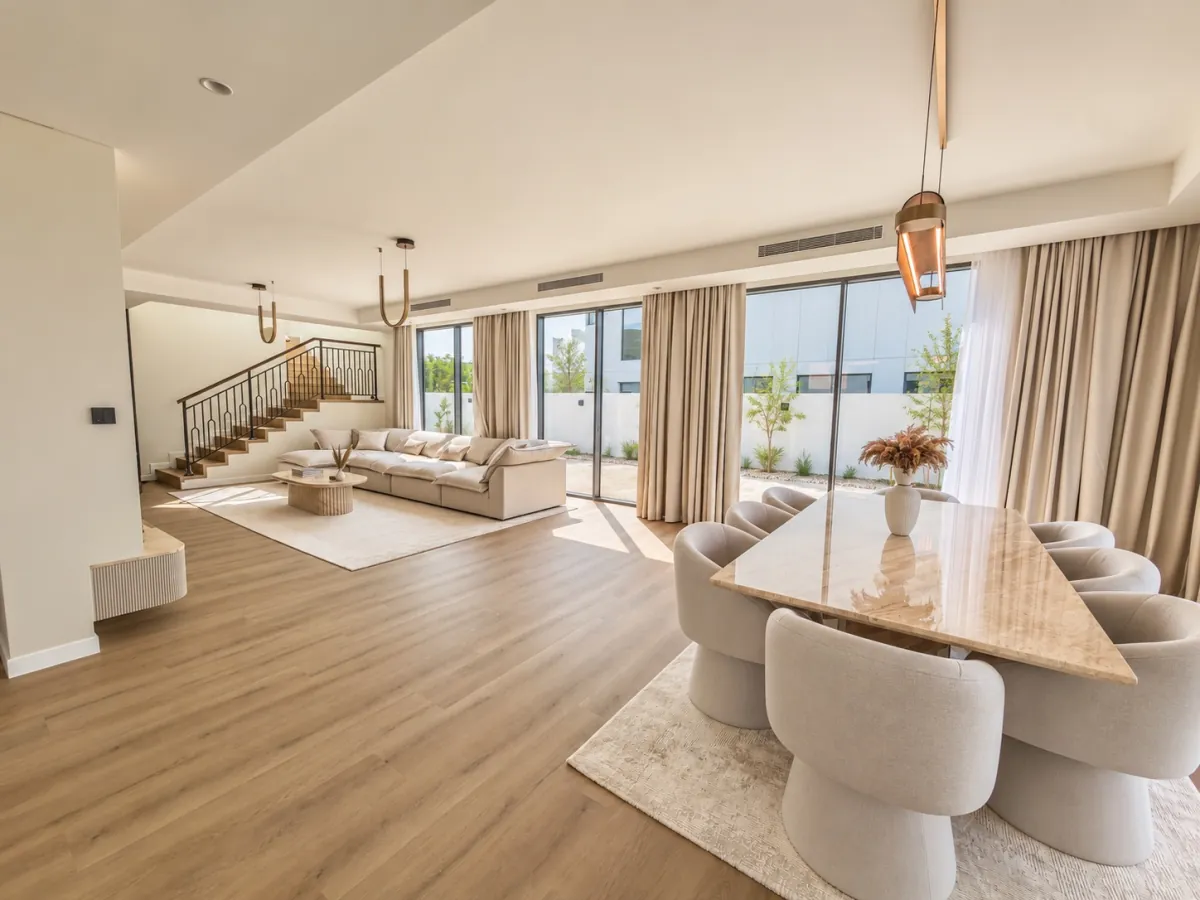
The look of oak, on a core that doesn't drink the air. That's why we fit SPC in most Dubai rooms, the kitchen and the bathrooms included.
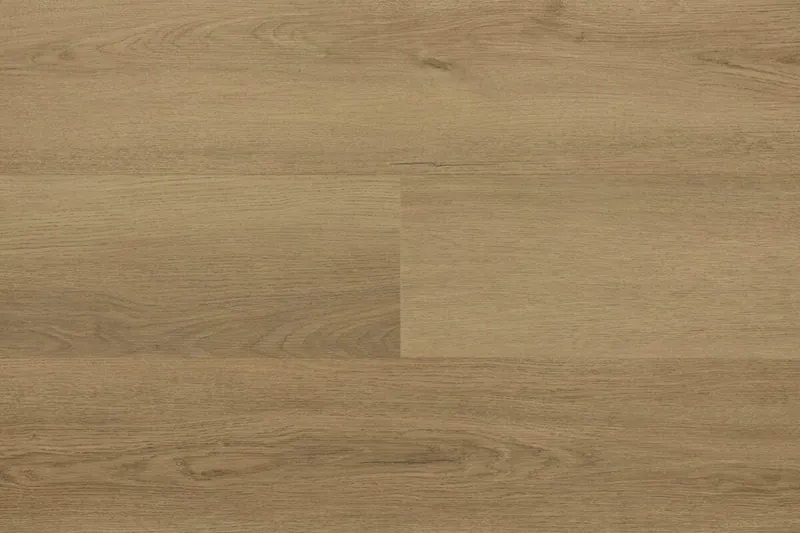
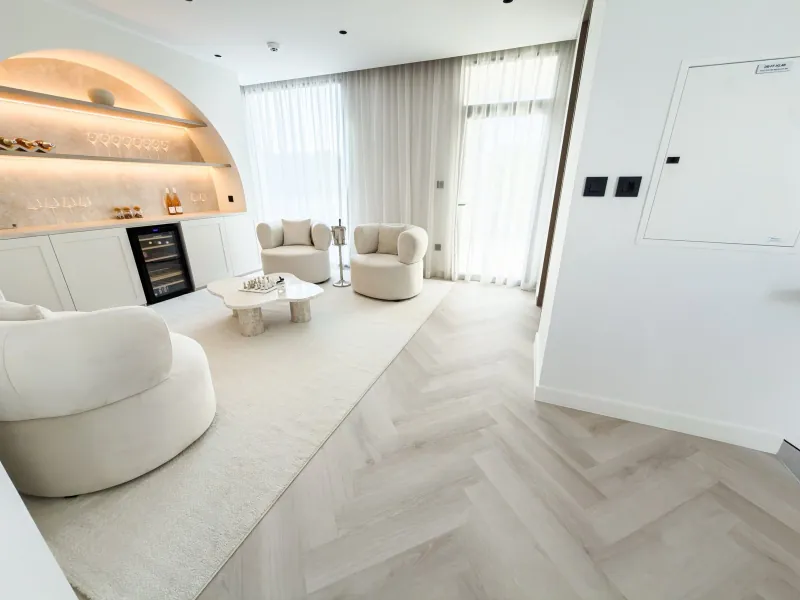
SPC is a rigid click plank. The core is limestone and PVC, the oak is a printed décor, and on top sits a clear 0.55 mm UV-cured wear layer. Our wood-look SPC flooring comes in twelve tones. The straight plank is 1,532 × 232 mm and 5.5 mm thick. The herringbone is 710 × 142 mm and 6 mm thick. The SPC flooring guide takes the plank apart layer by layer.
The humidity that swells oak doesn't swell SPC. Heat still moves it a little: after six hours at 80°C, its technical sheet allows no more than 0.15% change in size and 1 mm of curl.
LVT is the softer choice. Its core is cushioned, flexible PVC, so it's quieter and warmer underfoot. It's 2.5 mm thick, with the same 0.55 mm wear layer. Our LVT comes in the same twelve tones as the SPC. I'd look at it for bedrooms, and for upstairs rooms where footsteps carry.
Now the downside. The top's a photograph of oak. You can't sand it. When the wear layer finally goes, by a doorway say, the print goes with it. If a printed grain would bother you every time you looked down, a wood-look floor isn't for you.
Which floor goes in which room, from the kitchen to the main bedroom, is set out in SPC vs LVT vs engineered wood.
When is real wood still the right choice?
When you want a floor you can sand back and refinish, and your rooms can give timber a dry slab and steady air all year. Then buy engineered, from a timber specialist. It won't be us.
I'd keep it to the living room and bedrooms of a home where the AC runs steadily. Kährs does allow its wood floors in kitchens, if spills are wiped up quickly and oiled floors get extra coats. I still wouldn't put timber in a kitchen, a bathroom or by the pool door.
Real wood needs the room ready before it arrives. The Wood Handbook wants it delivered once masonry and plastering are "completed and fully dry", and not before. It also wants it checked with a moisture meter when it lands. Flooring acclimatisation covers how long each floor needs. Over underfloor heating or cooling, the rules get stricter, and the best flooring for underfloor heating has the limits.
Got a solid oak floor that's lived through several Dubai summers and is still flat? Keep it. When it's worn, have it sanded. That's the one thing a solid board does better than anything we sell.
Can wooden flooring go over tiles?
Usually, if it's a click floor that floats. SPC and floating engineered wood sit on the old floor rather than being glued to it. So sound tiles can stay, as long as they're stuck down, flat and dry. Kährs asks for a "dry, level, and clean subfloor" under its wood floors, and our installation team assesses yours on the site visit.
Floor levelling gives the flatness limit and shows you how to test a slab yourself. The tiles don't change what timber needs from the air above it, though.
A new floor on top of the old one also raises the level at every door. Settle the floor thresholds before the first plank goes down, not after.
What colours does wooden flooring come in?
In our wood-look range, twelve, from chalky white to charcoal: five light tones, four mid and three dark. Casablanca is a bleached white oak, Dune a warm honey oak, Tangier an espresso-stained oak and Sirocco a charcoal oak with a charred finish.
Read the undertone before the shade, then decide light or dark by the glazing and the Gulf light. Our guide to choosing a floor colour covers both, including the bad news for anyone hoping a pale floor will make a small room look bigger.
Real wood keeps changing colour after it's fitted. What holds its colour in Gulf sun compares timber with SPC under a Dubai window.
How do you clean a wooden floor in Dubai?
Sand off first, water second. Vacuum the grit up before a mop touches the floor. Keep the mop damp, not wet. On real wood, the cleaner has to suit the finish, oil or lacquer, so find out which you've got before you buy one. How to clean a floor when Dubai sand gets in has the routine, step by step.
What moves the price of wood flooring in Dubai?
We don't print prices, and we don't price timber at all now. Any floor's quote moves with the same five things. They're the material and its format, the area, the state of the subfloor, whether an old floor comes up first, and the skirting.
Real wood adds its own. How thick the top layer is, the plank size and the pattern all change the figure, which is why we priced our engineered oak per project rather than from a list. What goes into an SPC flooring price takes a quote apart line by line.
For your own rooms, a free site visit ends in a fixed-price quote within 48 hours.
What should you ask a wooden flooring supplier?
Is it solid, engineered, laminate or vinyl? "Wood flooring" and "hardwood" each cover more than one of those. Get the material written on the quote.
How thick is the top layer, in millimetres? On an engineered plank, it's all the wood you can sand. On SPC or LVT, it's the clear wear layer over the print, and ours is 0.55 mm. Ask to see the end of a plank.
What humidity does the warranty ask for? Get the band in writing, and ask who's meant to measure it. Ours on SPC reads "15 years residential and 10 years commercial, covering normal wear, fading and structural integrity". Ask us for its conditions too.
Who checks the subfloor, and when? Ask who tests the slab for moisture and level, and what happens if it fails. Any levelling or moisture barrier should be its own line on the quote.
Is the lead time on the quote? Ask for it in weeks. Without it, the fitting date is a guess.
A supplier who answers all five in writing is worth comparing. One who won't has told you something already.
FAQs
Look at the end of a plank. Real wood is timber all the way through, or a wood layer over plies, while SPC shows a thin grey core of stone and PVC under the print. Once it's fitted, the honest test is whether a printed grain would bother you, so look at a sample in your own light before you decide.
Yes. Put the SPC where water lands and the timber in the dry rooms. Our SPC is 5.5 mm thick, or 6 mm in herringbone, so ask the timber supplier for theirs and choose the door trims before either floor goes down.
No. Both the top layer and the core are wood, and wood swells when it gets wet. In a kitchen, a bathroom or by the pool door, fit SPC, and what survives a Dubai bathroom shows how to seal its edges.
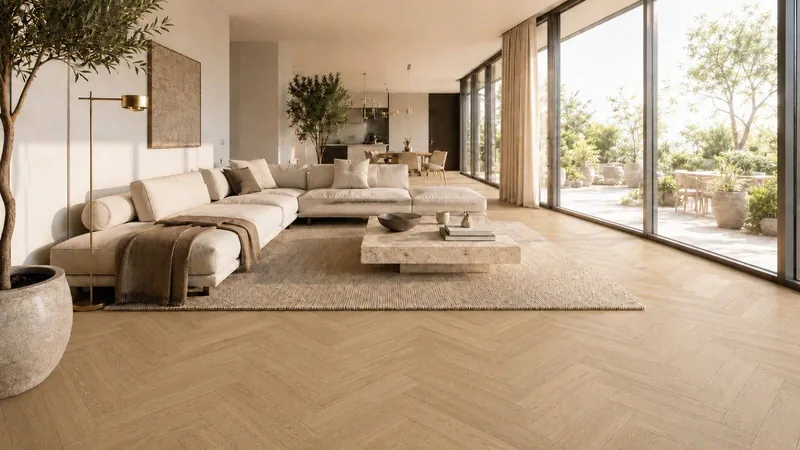
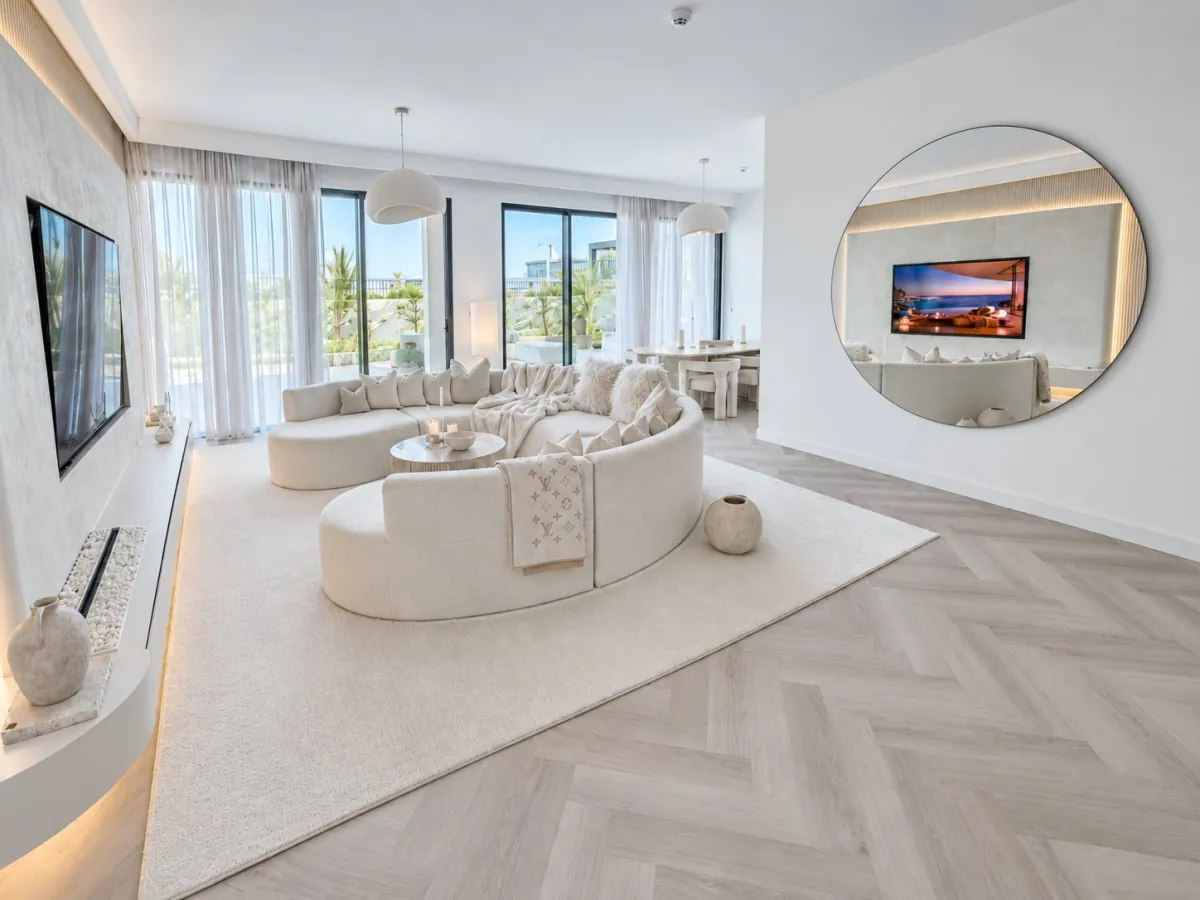
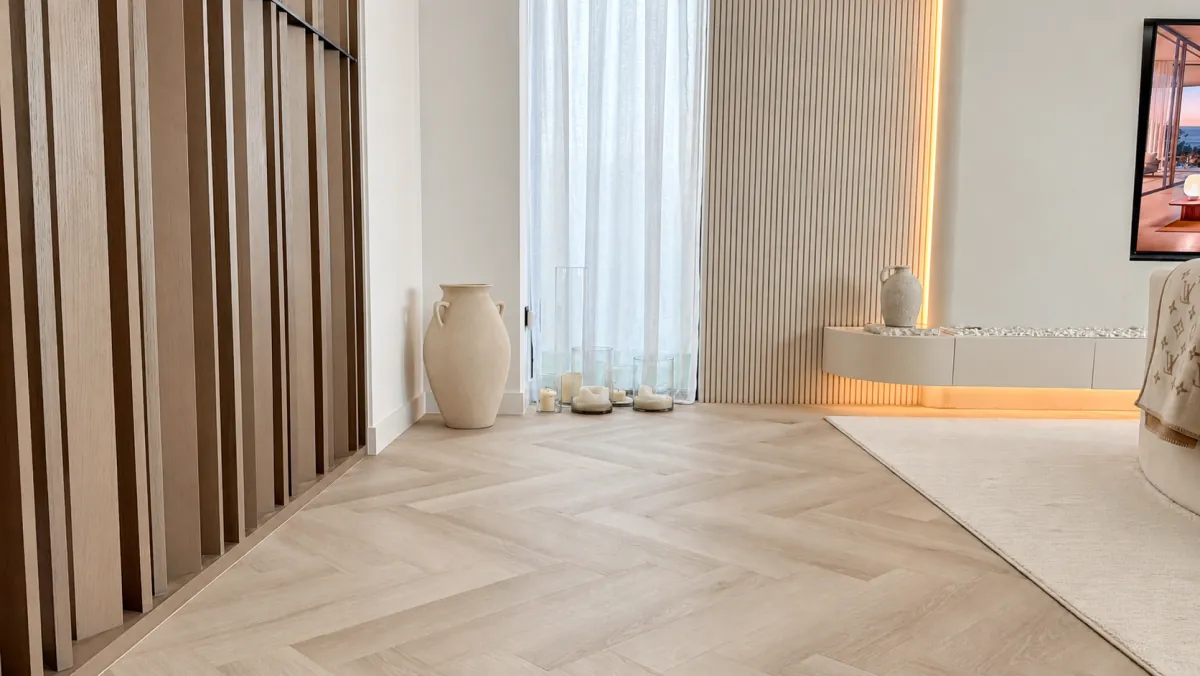
It can be, but it doesn't have to be. Herringbone is a laying pattern, so the blocks can be solid, engineered, laminate or SPC. Ours is SPC, in 710 × 142 mm blocks, and herringbone flooring or straight lay covers what the pattern does to a room.
Yes. The Wood Handbook's sum multiplies by the board's width, so a solid board twice as wide moves twice as far. Wide vs narrow plank flooring sets out what width changes, in timber and in SPC.
No. FSC traces the timber back to a forest managed to its standards. It says nothing about how the plank is made or whether it stays flat, and what FSC certified flooring guarantees explains what the labels do prove.
Wood is a beautiful floor that asks for a steady room. If yours can't promise one, put the look of wood on something that holds still.
Have a look at the wood-look colours on our SPC page first. When you're ready, book a free site visit. Someone from our team will come out and look at the rooms with you.