Vinyl flooring in Dubai: what it is, the types, and which to fit
Vinyl flooring is PVC, sold as a roll, a flexible LVT plank or a rigid SPC plank. Which one suits a Dubai home, what each needs, and where a roll wins.
By Stephen Pickering
Vinyl flooring is PVC flooring, and in Dubai it comes in three shapes: a roll of sheet vinyl, a thin flexible plank called LVT, or a rigid click plank called SPC. In most villas and apartments I'd fit SPC, because it floats over sound tiles and doesn't mind a spilt drink. LVT earns its place where the floor has to stay thin.
A roll still wins in one room: a wet room with a drain in the floor.
What is vinyl flooring, and is it the same as PVC?
Yes, it's the same thing. Vinyl is the everyday name for polyvinyl chloride, PVC. A shop selling PVC flooring and one selling vinyl flooring are selling the same plastic.
The Resilient Floor Covering Institute (RFCI), which speaks for the big North American makers of vinyl, rubber and linoleum floors, lists "vinyl (polyvinyl chloride or PVC)" among the materials in sheet vinyl (RFCI heterogeneous sheet declaration).
Resilient is the trade's word for the family. RFCI files vinyl beside rubber, linoleum and cork (RFCI flooring types).
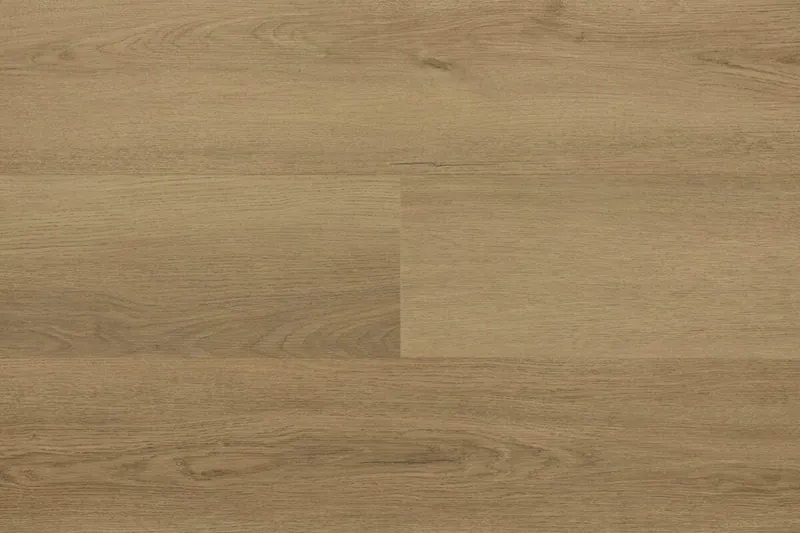
Most vinyl sold for homes is layered. A clear wear layer on top takes the scratches. Under it sits a printed picture of oak or stone, and under that, the core. The core is what separates one type from the next, along with how the floor's held down.
Worried about the PVC itself? What a new floor puts into the air walks through the emissions certificates and what to ask a supplier for.
What types of vinyl flooring are there?
Five, counted the way a fitter counts them. Here they are, from the thinnest to the stiffest.
Sheet vinyl. It comes off a roll, typically 6 ft or 12 ft wide, about 1.8 m or 3.7 m, so a bedroom can be a single piece (RFCI on sheet vinyl). Homogeneous sheet is a single layer, coloured all the way down. Heterogeneous sheet has a print under a wear layer. A wood-look roll is the layered kind. Most sheet is glued down.
Glue-down LVT. Thin, flexible planks or tiles, set into adhesive on the screed. RFCI calls it dry-back. Karndean's glue-down guide wants the subfloor "firm, hard, flat, level, smooth, dry, clean" before a plank goes down (Karndean glue-down installation guide).
Click LVT. The same flexible vinyl with a locking edge, so the planks hold each other and float. RFCI lists three ways LVT goes down: glued, floating on a click joint, and loose-lay, which uses little or no adhesive (RFCI on flexible LVT).
SPC. A rigid core of limestone and PVC, with a click joint, floating. Ours is 5.5 mm, with 1 mm of foam attached underneath. Our SPC flooring guide covers its layers, its pros and cons, and the detail of fitting it over tiles.
WPC. Another rigid core, this one built round an expanded polymer core that RFCI describes as "light in weight" (RFCI on rigid core). We don't sell it, and the SPC guide sets the two side by side.
RFCI puts SPC and WPC in a class of their own, rigid core, apart from flexible LVT. That's the split that matters in a Dubai flat with a tired screed. RFCI says a rigid floor usually copes with small flaws in the subfloor better than a flexible one. That's the reason I'd start with SPC.
What does LVT flooring mean?
Luxury vinyl tile. RFCI defines it as "a type of flexible resilient flooring produced in either tiles or planks". LVP, luxury vinyl plank, is the same floor cut as planks, and RFCI files the two together as LVT/LVP. Planks or tiles, glued or clicked, it's all LVT.
Don't buy on the word "luxury". It's a name, not a grade. Ask for the wear layer in millimetres and the warranty in writing.
Our LVT flooring is 2.5 mm thick, with a flexible, cushioned PVC core and a 0.55 mm UV-cured wear layer. It comes in the same 12 tones as our SPC. The warranty's 10 years residential and five years commercial, covering wear, fading and structural integrity.
Its technical sheet records it bending round a 50 mm tube without cracking, and we offer it for borders, inlays and patterned floors, which our SPC doesn't do.
LVT is sold both glued and clicked, so ask which one you're being quoted. It changes what the floor underneath has to be. Ask about stock, too, before you settle on a colour.
When is vinyl sheet flooring the right choice?
When the room gets wet every day and the water mustn't reach the slab. A sheet's seams can be welded, so the whole room becomes one surface, and no plank floor can match that.
RFCI's sheet declaration says the seams "can be welded to create a contiguous flooring solution", with an integral cove that carries the floor up the wall. Altro's technical guide for wet rooms shows how it's done (Altro wet rooms and bathrooms guide).
The sheet is turned up the wall over a cove former, the joints in the cove are hot welded, and the sheet is welded to the drain.
So in a wet room with a drain in the floor, a welded sheet is the vinyl I'd choose, and tiles are the other honest answer. A click floor isn't. Karndean won't have its rigid core fitted in rooms "that will be continually wet" (Karndean rigid core installation guide).
The sheet's other strength is budget. RFCI calls heterogeneous sheet "a great choice for budget-conscious consumers".
Its weak points are the fitting and the look. RFCI says the job takes "excellent cutting and seaming skills". The boards on a wood-look roll are printed, with no real joints between them. And a damaged patch can't be lifted out the way a plank can.
The FloorHaus doesn't sell sheet vinyl. If your room needs one, get the quote from a fitter who welds seams every week.
Which vinyl flooring suits a Dubai home?
Rigid SPC, for most rooms. A Dubai home asks four things of a floor: heat, sun through big glass, air conditioning running against the humidity outside, and sand. Here's how vinyl meets each one.
Heat. Our SPC passes a 6-hour test at 80°C under ISO 23999: it moves no more than 0.15% and curls no more than 1 mm. Our LVT sheet allows up to 0.25% and 2 mm on the same standard.
Sun through glass. Karndean asks for a 10 mm expansion gap, double its usual 5 mm, where its rigid core gets direct sun through glass doors. For glue-down LVT beside floor-to-ceiling glazing, where the floor could pass 50°C, its glue-down guide calls for a two-part chemical-cure adhesive and the windows shaded for at least 48 hours after fitting.
Fading is the other half of sun, and which floors hold their colour in Gulf sun compares them.
Air conditioning and humidity. There's no wood in a vinyl core to swell. Karndean still wants its rooms held between 18 and 27°C for fitting, so the AC goes on before the planks come in.
Sand. Grit is what wears a vinyl floor down, and the wear layer is what it wears through. Ours is 0.55 mm on both SPC and LVT. Our SPC flooring guide explains why that number counts for more than the plank's thickness.
If the villa has underfloor cooling or heating, our SPC is rated for a surface up to 28°C. The best flooring for underfloor heating sets out the limits floor by floor.
Can vinyl flooring go over existing tiles?
Usually. The work depends on one thing: does the floor click or glue?
A rigid click floor floats, so sound tiles can stay. Karndean's rigid core guide asks for loose tiles to be fixed, grout lines wider or deeper than 5 mm to be levelled, and no dip of more than 5 mm over 3 m. On flat, well-stuck tiles, that's a small job.
Click LVT is flexible, so ask for its own maker's tolerance; don't assume the rigid figures carry over.
A glued floor is a bigger job. Karndean's glue-down guide says tiles usually aren't absorbent enough for the adhesive. They either come up, or they're cleaned, abraded, primed and given a levelling compound until no grout line shows through, sometimes in two coats. Sheet is glued too, so ask its fitter what your tiles need.
Two more things change when the new floor sits on the old one. The floor gets higher, so plan the thresholds between rooms and check every door clears it. And if the tiles aren't flat, floor levelling comes before anything else.
In an apartment, check what the building wants first. Installing flooring in an apartment covers the NOC and the service lift.
Is vinyl flooring waterproof?
Not as a whole floor. I'd call a click vinyl floor water-resistant, which is the word our SPC page uses. RFCI chooses it too: rigid cores have "water resistant capabilities".
The gaps are the difference. A floating floor has joints between planks and an expansion gap at every wall, 5 mm at least in Karndean's guide. Water that finds the gap ends up on the slab underneath, where you can't dry it.
So a spill in the kitchen is fine. Karndean says spills "cleaned up promptly will not harm the performance of the floor". A shower floor that runs with water every day is another matter.
The sealed edges and slip ratings for bathrooms are in what survives a Dubai bathroom.
Vinyl or tiles: which is better for a Dubai home?
Tiles are better inside a shower, round a floor drain and anywhere water stands. I wouldn't swap them out there.
Vinyl's better almost everywhere else, for three reasons. It can go over the tiles you have, so there's no breaking out and no rubble in the service lift. It's softer and quieter underfoot. The attached foam on our SPC cuts impact sound by 19 dB in its acoustic test, which the people below you will notice. And a damaged plank can be swapped out on its own.
If your tiles are sound and you like them, keeping them is a fair answer too. Nobody needs a new floor because a brochure said so.
How thick is vinyl flooring?
The floors in this guide run from 2 mm to 6 mm. RFCI's sheet declaration models heterogeneous sheet at 2.00 mm. Our LVT is 2.5 mm. Our SPC is 5.5 mm as a straight plank and 6 mm as herringbone, with the 1 mm of foam included.
Thickness buys feel, sound and height at the door. It doesn't buy durability. The wear layer does. Both our vinyls carry the same 0.55 mm wear layer, so the 3 mm between them sits in the core and the backing, not in the surface you walk on.
How long does vinyl flooring last?
There's no honest single figure, and I'd be wary of anyone who gives you one. RFCI's sheet declaration assumes 30 years for its environmental sums, then says the real service life "varies based on the manufacturer's warranted lifetime".
So the warranty is the number in writing. At The FloorHaus, it's 15 years residential and 10 commercial on SPC, and 10 residential and five commercial on LVT, both covering wear, fading and structural integrity. Read a warranty as a floor under the maker's cover for that term, not as the day it wears out.
Grit decides the rest. Sand carried in on shoes is what wears through the top layer. A mat at every garden door does more for a vinyl floor's life than an extra millimetre of plank.
What decides the price of a vinyl floor?
The type, and what the room needs before the floor goes down. A rigid plank over sound tiles is a different job from glue-down vinyl that needs a full levelling coat first. Skirting, trims and taking up the old floor each add a line.
I won't print a figure here, because prices move. What goes into an SPC flooring price breaks a quote down line by line, and we price every job after seeing the room.
Where does vinyl fit among the types of flooring for a Dubai home?
The floors you'll be offered in Dubai mostly come down to four. Here's where I'd put each one.
Porcelain and ceramic tiles. What most homes here already have. Unbeatable inside a shower, and the floor vinyl most often goes on top of.
Vinyl. SPC, LVT or sheet, as above. For the rest of the house, it's the widest choice of the four.
Laminate. From standing height it can pass for a vinyl plank, but its core is compressed wood fibre, which I wouldn't put under a kitchen. Laminate vs SPC sets out the rooms where it's still a fair buy.
Engineered wood. Real oak on top, which can be sanded and refinished, on a ply core. If you want timber underfoot, wooden flooring in Dubai covers it, solid wood included. Keep it out of the bathrooms.
What I'd fit in my own villa
SPC through the living room, the kitchen and the hallways, and across the bathroom floors with the edges sealed. Tiles inside the walk-in shower. I'd only reach for LVT where a door couldn't take another 5.5 mm, and I'd only lay a roll in a room built as a wet room.
FAQs
It can be when it's wet, like most smooth floors. Our SPC and LVT technical sheets both rate the surface R9 or better on the DIN 51130 ramp test. By a shower, a bath mat does more for your footing than any rating on a sheet.
Our LVT sheet records only a slight change after the ISO 4918 castor chair test, and no visible change after the EN ISO 16581 furniture leg test. Our SPC passes the castor chair test at the moderate commercial level. Felt pads under chair and table legs still help, on any floor.
No. The Resilient Floor Covering Institute lists linoleum as a resilient floor in its own right, made from natural ingredients, while vinyl is PVC. People swap the two names in conversation, so check which one a quote means.
It depends on the product, so read its sheet. Our SPC and LVT are both listed as Class Bfl-s1 under EN 13501-1, the European reaction-to-fire classification. If a building or a developer's specification asks for a fire class, that's the line to show them.
A plank floor can. RFCI counts it among the benefits of a modular floor: one damaged plank or tile can come out and a new one go in. Keep a few spare planks from the job for exactly that. A welded sheet is one piece.
It's all PVC. The core, and the floor it's going on, decide which vinyl belongs in your home.
If you'd like someone to check the floor you've got, book a site visit. We'll come with SPC and LVT samples, and tell you which vinyl your rooms will take. You can browse the SPC colours before we come.