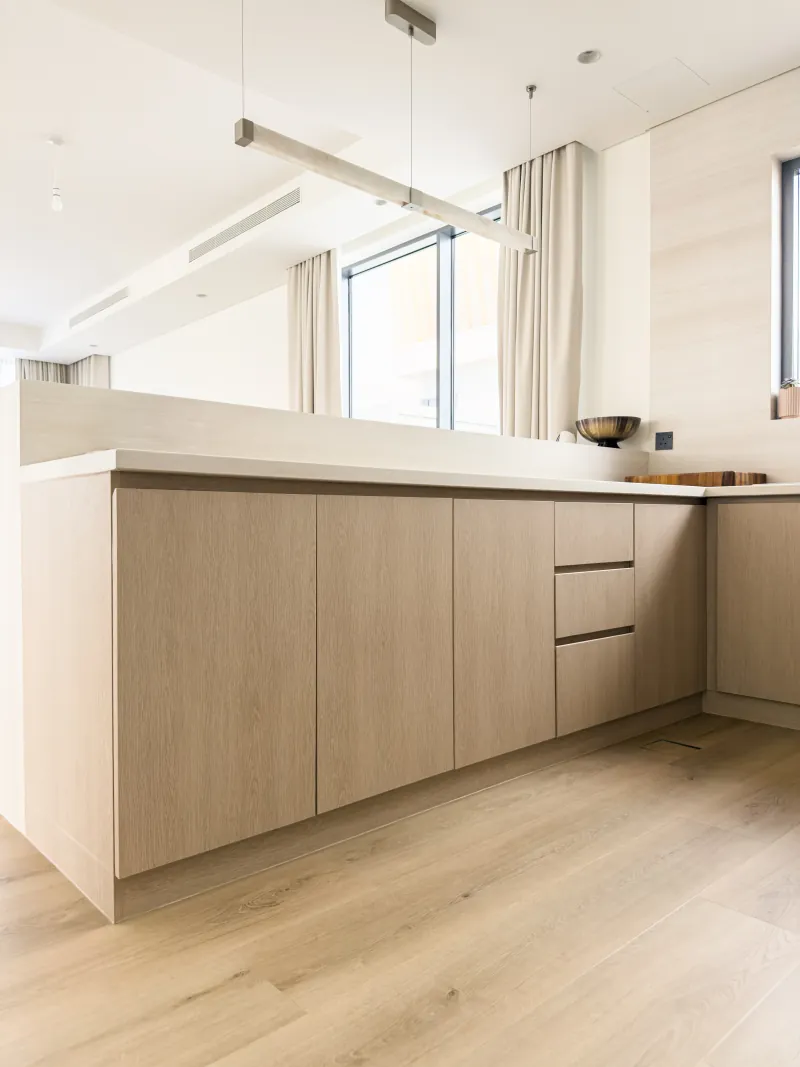
Kitchen wrapping in Dubai: is it worth it, and where does it fail?
Kitchen wrapping is worth it when your cabinets are sound and only the finish has dated. Where film fails in a Dubai kitchen, and what sets the cost.
By Stephen Pickering
Kitchen wrapping is worth it when the cabinets are sound and only the finish has dated. A thin vinyl film goes over the doors, drawer fronts and panels you already own, and most jobs take one to three days. It won't fix a swollen carcass or a layout that doesn't work, and I wouldn't wrap a worktop you cook on.
Is kitchen wrapping worth it?
Open a few cupboards before you decide. If the carcasses are square and dry, the drawers run true and the layout still suits how you cook, a new kitchen means paying to replace boxes that work. A wrap changes the one thing that's aged: the surface.
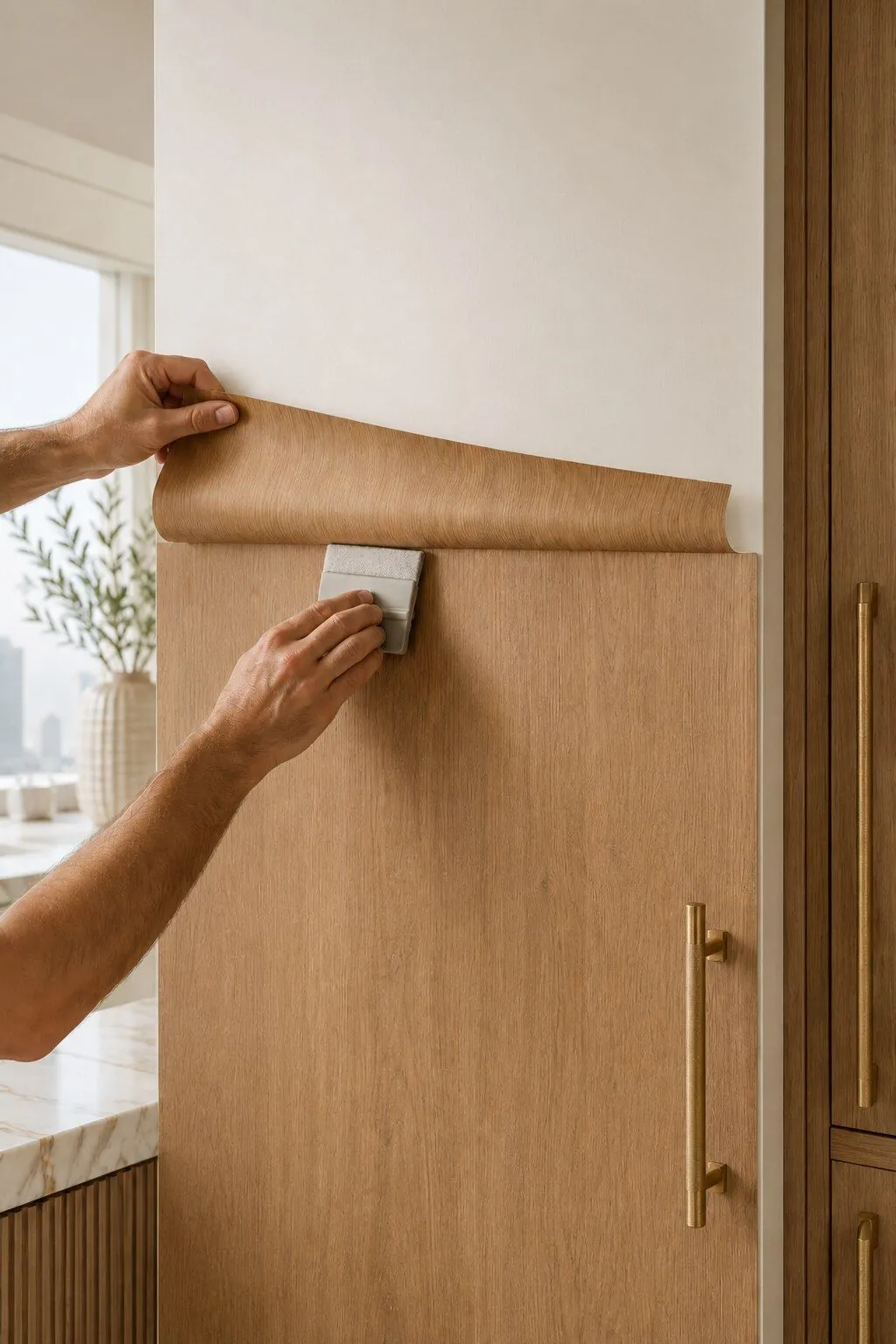
The film itself is PVC: 3M's measures 0.21 to 0.25 mm thick, adhesive included (3M DI-NOC product bulletin). Our door and wardrobe wrapping guide covers what's in it and how a single door gets done.
Three things make a kitchen a poor candidate.
A swollen base unit. If the cupboard under the sink has swollen after a leak, film won't flatten it. You'll have a new finish on a damaged board.
A finish that's already lifting. Old foil or paint that's coming away at the edges has to come off before anything goes on. LX Hausys lists flexible PVC among the surfaces it especially doesn't recommend for its film (BENIF installation manual).
A layout that's wrong. If the fridge is in the wrong corner or there's nowhere to put a pan down, a wrap gives you the same kitchen in a nicer colour.
A tired hinge or a sticking drawer runner isn't on that list. Those can be changed while the doors are off.
Which parts of a kitchen can be wrapped?
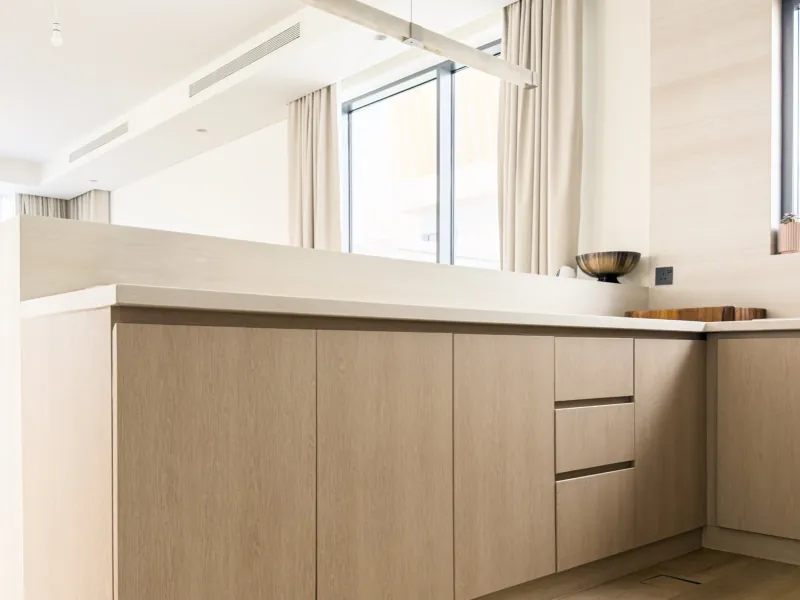
Kitchen cabinet wrapping covers most of what you see. Our kitchen wrapping service takes in carcasses, cabinet doors, drawer fronts, range hoods and appliance fronts. In a typical kitchen that means the doors and drawer fronts, the exposed end panels, the plinth along the floor, the sides of an island and the tall housings around a fridge. Integrated dishwasher and fridge doors are cabinet doors fixed to an appliance, and they wrap like the rest.
There are two surfaces I'd leave alone.
The worktop. 3M says a film used on a counter takes more abrasion than one on an upright surface, which "can lead to premature wear", and it sells a separate abrasion-resistant series for counters. Hornschuch goes further: its d-c-fix FAQ says its standard films aren't suitable for kitchen worktops, because of contact with food and the heat around the stove and oven (d-c-fix FAQ). If the worktop has dated, price a new one as its own job.
The splashback behind the hob. Hornschuch tells customers not to fit its glass film behind stoves or on or above ovens, because of the heat. Leave the tiles or glass behind the hob as they are, and change the cabinets around them.
Can a kitchen wrap cope with heat and steam?
Warm air, yes. A hot surface, no.
Hornschuch says a short spell of extra heat, such as direct sun, doesn't trouble its film. Sustained heat is another matter. 3M's warranty doesn't cover film "exposed to excessive heat, humidity, dirt or UV light" (3M DI-NOC installation guide). Cover Styl', writing about counters in restaurant kitchens, names stovetops and steam off boiling pans as the hazards, and advises a wrap that can take up to 80°C (Cover Styl', March 2025). So ask which film you're getting and what temperature it's rated to, in writing.
In a home kitchen, four places take the heat and the steam:
- the panel beside a freestanding cooker, and the housing round a built-in oven
- the wall cupboard above the kettle or the coffee machine
- the dishwasher door and the drawer above it, when it's opened at the end of a cycle
- the cabinet sides closest to the hob
Move the kettle out from under the wall cupboard. Let the dishwasher cool before you open it, if you can. And I'd rather leave the one panel that sits against an oven as it is than wrap one the makers' warranties wouldn't cover.
What does kitchen grease do to a wrap?
Before the job, grease is the adhesive's enemy. Cover Styl' tells installers to use a strong degreaser to get off "all grease, oil, and food residues" first. LX Hausys has the surface wiped down with thinners. The doors nearest the hob carry years of cooking residue, so that's where a careful fitter spends the time.
After the job, the makers agree on gentle. 3M's bulletin says mild detergent and water on a soft cloth, and for heavier dirt, detergent in water at 70 to 80°C, then clean water. LX Hausys adds a 70/30 mix of isopropyl alcohol and water for marks that won't shift (BENIF installation manual).
3M rules out anything above pH 11 or below pH 3, plus ammonia, chlorine and hard-bristle brushes. LX Hausys says strongly alkaline or acidic products damage its film. Read the label on a kitchen degreaser or an oven cleaner before it goes anywhere near the doors.
Should you wrap, paint, reface or replace your kitchen?
| Wrap | Paint | Reface | Replace | |
|---|---|---|---|---|
| What changes | The surface of doors, fronts and panels | The colour | New doors and drawer fronts | The whole kitchen |
| Carcasses kept | Yes | Yes | Yes | No |
| Finishes | Wood, stone, metal, textile, solid colours | Solid colours | Whatever the new doors come in | Whatever the new kitchen comes in |
| Time out of use | Most wraps take 1 to 3 days | Until the paint hardens | While new doors are made and hung | Strip-out to handover |
| Fixes swollen or broken units | No | No | No | Yes |
| Changes the layout | No | No | No | Yes |
| Goes in the skip | Film offcuts | Very little | The old doors | The old kitchen |
Wrap if the units are sound and you want wood, stone or metal, not only a new colour.
Paint if a solid colour is all you want and you can manage without the kitchen while it hardens.
Reface if the doors themselves are chipped or warped but the boxes behind them are fine. That's a joiner's job, not ours.
Replace if the layout's wrong or the carcasses have gone. No film fixes either.
What decides the cost of kitchen wrapping, and the time?
Count fronts, not metres. Six things decide how much work a kitchen is.
How many fronts there are. Each door and drawer front is wrapped on its own, edges included. A kitchen with lots of shallow drawers takes longer than one with a few tall doors.
The profile. Flat slab doors are quickest. Shaker frames, grooved handles and curved end panels take more heat, more trimming and more film: LX Hausys cuts film 100 mm larger than the panel for a curved edge, and 3M allows 3 inches (about 75 mm) round the whole panel.
What else is on the list. End panels, plinths, island sides, the hood and appliance doors all add up.
The preparation. Degreasing, filling dents, sanding and priming every edge.
The finish. Metallic and high-gloss films need a flatter base than woodgrain (more on that below).
The hardware. Handles and hinges come off before the film goes on and go back on after.
Most of our wrapping projects take one to three days, and our wrapping page says most kitchens are done in a long weekend. The same page puts a typical wrap at 60 to 80% less than a full refit. The number that counts is your own quote, once we've measured the kitchen. Here's how our site visit and fixed quote work.
Which finishes and kitchen cabinet colours work in a wrap?
Choose against what isn't changing. The worktop, the splashback and the floor stay, so the doors have to agree with them. Read a finish's undertone the way you'd read a floor's, against the stone.
The range is wide. Our wrapping page shows ten finishes, from Linen and Carrara to Brass, Tobacco and Ebony, and the brochure there runs to oak, walnut, teak and ash woodgrains, solid colours, painted wood, concrete, fabric, leather, metal and marble. Matt, gloss and textured surfaces are all available.
Four things narrow it down in a kitchen.
High gloss and metal show the door underneath. LX Hausys warns that any flaw in the surface below may show through its high-gloss metallic film. It also says not to stretch that film over 3D curves, because stretching changes the colour and pattern. I'd keep metal for flat slab doors.
Woodgrain has a direction. LX Hausys says embossing has a directional pattern, and panels fitted the opposite way can look like a different colour. Every door should run the same way.
One kitchen, one batch. LX Hausys asks for film from a single lot number in any one space, because colour varies slightly between lots (BENIF technical data sheet). On a quote, that's a line worth seeing.
Deep texture holds grease. LX Hausys suggests a soft brush for anything caught in the embossing. A fabric or leather finish is lovely on a pantry door. I'd think twice beside the hob.
Samples of the finishes are free, so look at yours in your own kitchen light before you choose.
How long does a kitchen wrap last?
There's no single figure. The doors in a kitchen don't all live the same life.
3M gives its interior film an expected life of 12 years on upright surfaces, including in the Gulf, where "interior" means out of direct sunlight. It adds that "a significant decrease in durability may be experienced" on anything that isn't vertical. LX Hausys warrants its film for 10 years against discolouring and cracking, only with no direct UV and away from heat and moisture, and it doesn't cover adhesion once the film is fitted (BENIF warranty).
So a tall door on the far wall is the easy case. These shorten a wrap's life:
- heat and steam at the oven, kettle and dishwasher
- water at the sink base and along the bottom edge of the doors
- direct sun through a kitchen window
- knocks on drawer edges from pans and hips
- strong cleaners
- grease or dust left under the film on fitting day
Edges take the knocks and the water, so they're the part to ask about. 3M has installers take adhesion promoter at least half an inch round onto the back of a panel before the film is folded over it. Ask how yours will be finished.
Can you renovate a kitchen in Dubai without replacing it?
Often, yes. It's a kitchen renovation in Dubai without a skip. Keep the carcasses. Wrapping kitchen units changes the doors, fronts and panels and leaves the boxes where they are. Change handles and hinges while the doors are off. Replace the worktop only if it's actually the problem.
In an apartment, that matters more than the money. A full refit in a tower means approvals, deliveries, a skip and service-lift bookings. Our notes on what changes between an apartment and a villa cover the service lift and the neighbours below.
There's a waste argument too. 3M points out that its film can refinish reused interior materials, which cuts construction waste. A replaced kitchen sends sound cabinets to landfill so that new board can fill the same space.
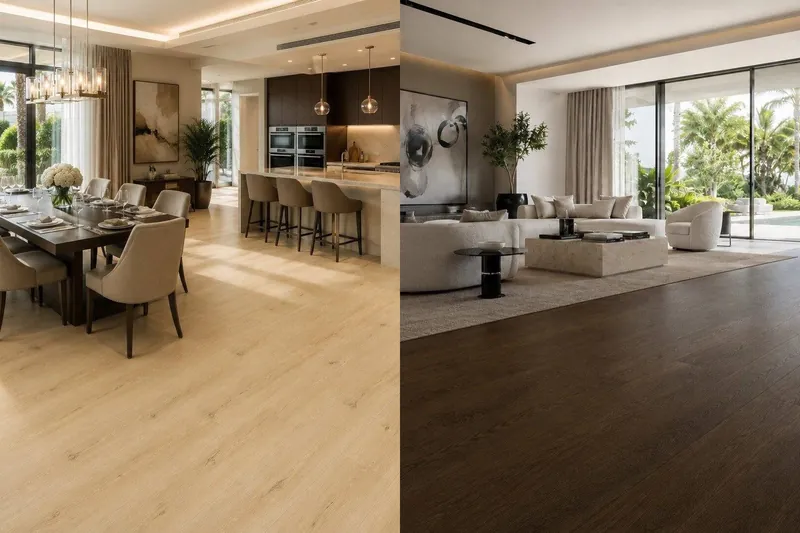
If the floor's tired as well, read laminate against SPC in a Dubai kitchen before you choose.
What else can be wrapped besides a kitchen?
Most interior wrapping is the same job on a different piece of furniture. Our wrapping page lists wardrobes, internal doors, vanities, feature walls, built-in joinery and office desks. 3M also suggests its film for refinishing reused furniture.
Doors and wardrobes have their own questions, from fire labels to mirrored sliders, and our guide to door and wardrobe wrapping answers them. Bathrooms are harder. The makers disagree about film near water, so check the film's own sheet, and read what survives a Dubai bathroom before you change anything on the floor.
FAQs
Usually. LX Hausys lists acrylic, MDF, melamine and veneer among the surfaces its film goes on, once they've been prepared. On a painted or lacquered door, its manual tests a small piece of film first, to check the paint will hold.
Not on its own. LX Hausys's manual fills uneven areas with putty and sands them flat before any film goes on, and warns that dust trapped underneath shows through the surface. A dent nobody fills is still there under the new finish.
Same idea, different film. 3M describes its DI-NOC range as decorative finishes for interiors, ideal for walls, doors and cabinets. Ask for an architectural or interior film by name, not a vehicle wrap.
Yes, if the old film is still stuck down. 3M lists its own DI-NOC film among the surfaces a new layer can go on, with primer. If the old film is lifting or bubbling, it comes off first.
For a landlord between tenants, it's a quick way to make a sound kitchen look current, since most wraps take one to three days. Taking it off later needs heat, and 3M gives no promise about how easily or quickly a film comes off.
Yes. There's no demolition and no skip, and our wrapping page says you can live at home throughout.
A wrap is a new surface on a kitchen you'd otherwise keep. It isn't a new kitchen.
Browse the finishes and download the free brochure on our wrapping page, then book a site visit and we'll open your cupboards and tell you honestly whether yours should be wrapped.