Door wrapping and wardrobe wrapping: what film can and can't fix
Door wrapping in Dubai works when the door or wardrobe is sound, flat and dry. Film changes the finish. It won't fix what's underneath it.
By Stephen Pickering
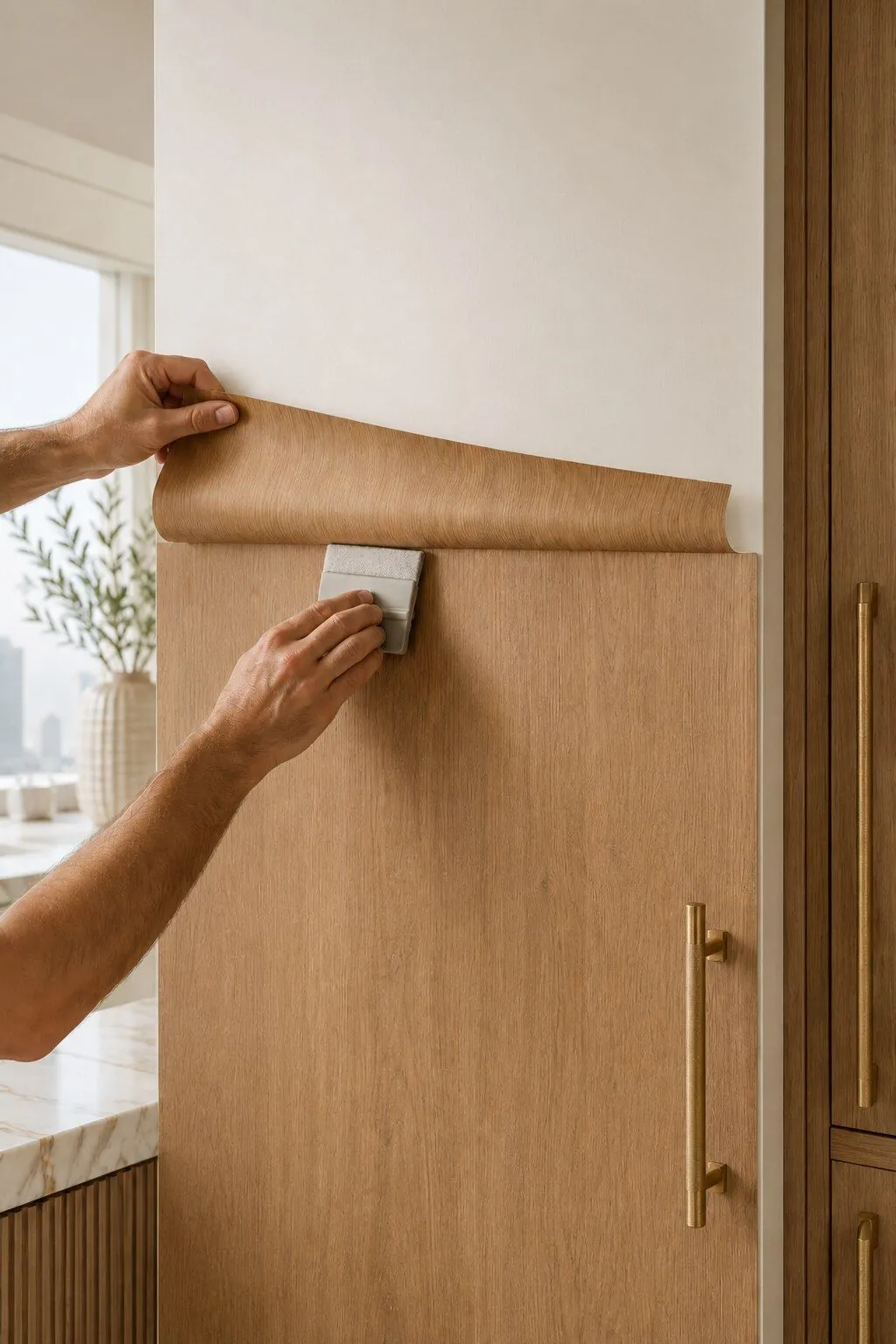
Door wrapping covers an existing door or wardrobe front in a self-adhesive architectural film, printed to look like wood, stone, metal or a plain colour. It works when the door is sound, flat and dry, and only the finish has dated. It won't straighten a warped door or hold onto peeling paint.
I'd wrap a sound bedroom door or a tired wardrobe without much thought. I'd look harder at a bathroom door, and I wouldn't let anyone wrap a fire door on a guess. Whatever the door, I'd judge the quote on the preparation, not the film.
What is the film made of?
PVC, about a quarter of a millimetre thick, with an acrylic adhesive on the back. 3M puts its DI-NOC film at 210 to 250 µm, adhesive included (3M product bulletin). Cover Styl' gives 250 µm for its AF08 wood finish (Cover Styl' AF08 sheet).
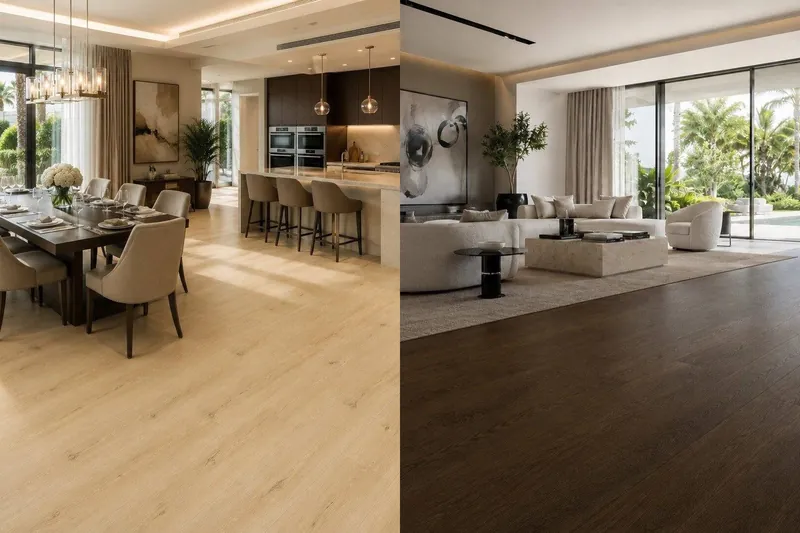
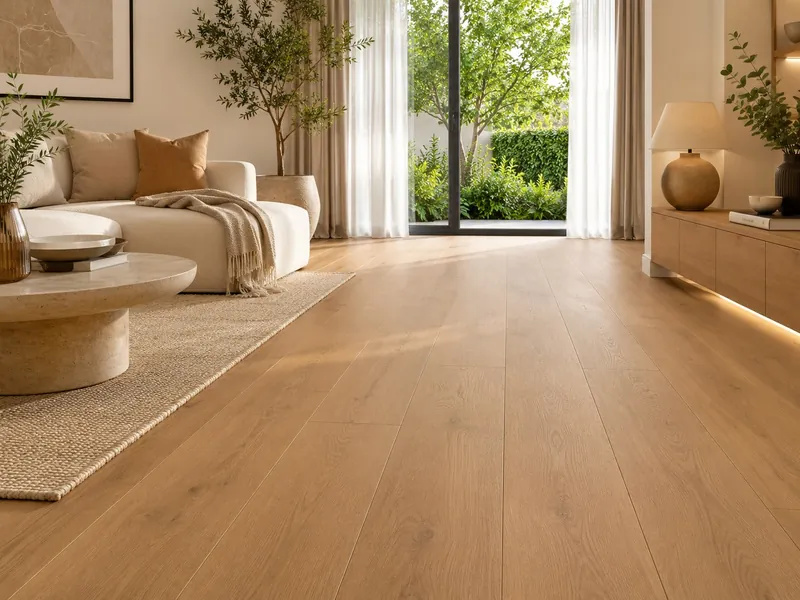
3M lists doors and cabinets among the film's uses, in over 1,000 designs. Pick one the way you'd pick a floor: read the finish's undertone first, against the stone and the floor already in the room.
How is a door wrapped?
Ideally, off its hinges. LX Hausys, which makes BENIF film, says it's easier to take the door out of its frame and lay it flat on a table. Locks and handles come off (BENIF installation manual).
The surface gets filled, sanded and cleaned. 3M says to wipe it twice with 70% isopropyl alcohol, then wait about 10 minutes (3M installation guide).
Primer goes on the edges and corners. Flat faces generally don't need it, 3M says, but anywhere the film's stretched does. On veneer, 3M measured the film's grip at 4.9 N/25 mm without primer and 34.3 with it (3M technical data, 2011). That's seven times the hold.

The film's pressed down with a squeegee, then warmed with a heat gun so it'll bend round the edges. Too much heat damages it. Outside corners are cut at 45°.
The room matters too. LX Hausys wants it between 15°C and 25°C for 72 hours before the job, and for 48 hours during and after (BENIF data sheet). In a Dubai summer, leave the air conditioning on.
Which doors and wardrobes can be wrapped?
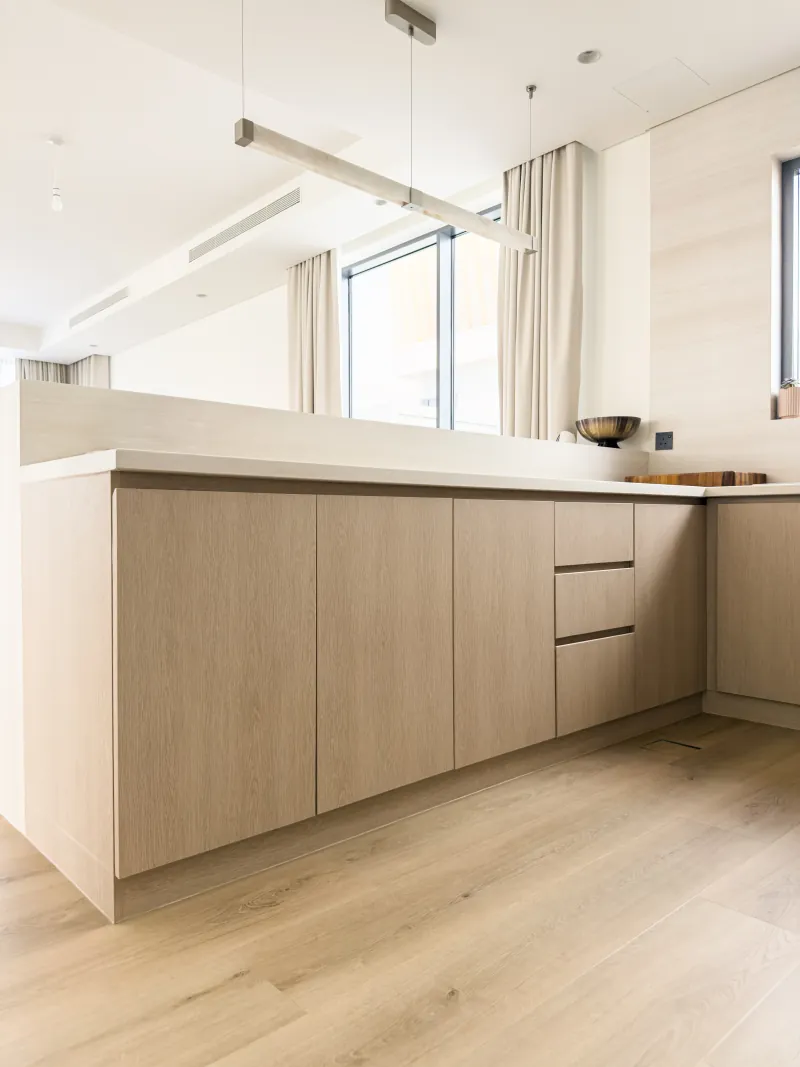
Most flat, sound ones. We offer door and wardrobe wrapping alongside kitchens and bathrooms. These are the six checks I'd make first.
Painted MDF, melamine and veneer: yes, after preparation. They're all on LX Hausys's lists. Melamine's sanded, cleaned with solvent and primed. Veneer can carry oil or wax, and REATEC says every trace has to come off (REATEC application guide).
Painted doors: only after a test patch. If 3M's test strip pulls paint off, nothing goes on until the paint's fixed. Low-VOC paints vary. Film "may perform well on one paint and poorly on another", 3M says, so ask for a patch on your own door.
Peeling, blistered or damp surfaces: no. 3M says film over "peeling, lifting, bubbling, or dampness" is likely to fail. It also shows what's under it: REATEC warns that trapped dust leaves "noticeable lumps, bumps, or bubbles". REATEC rules out solid timber, too, unless it can be sealed for good.
Glass and mirror wardrobe doors: watch the sun. 3M warns that a dark or opaque film can absorb enough heat to break the glass. It doesn't recommend those films on glass that gets a lot of sun. A mirrored slider that catches the afternoon sun is one I'd leave alone.
Bathroom doors: the makers disagree. Cover Styl' rates AF08 for "direct water contact areas". LX Hausys's BENIF warranty covers only "heat & moisture free areas", and 3M's excludes "excessive heat, humidity". It depends on the film. I'd want that film's own sheet before saying yes. If the vanity and doors have dated but the tiles haven't, what survives a Dubai bathroom covers the rest of the room.
Fire doors: check the label first. A film's fire class belongs to one product on one backing. A French certificate classed Cover Styl' film M2 when "glued on any wood-derived panel classified M1" (CSTB, 2017). REATEC holds a UL 10B and 10C certificate for its own film on the door types it names (REATEC technical information). Neither makes a wrapped door fire-rated. If yours carries a fire label, ask the building and the door's maker before anyone touches it.
Door wrapping vs painting vs replacing
| Wrap | Paint | Replace | |
|---|---|---|---|
| What changes | The surface | The colour | The door or front |
| Finishes | Wood, stone, metal, plain colours | Plain colours | Whatever the new door comes in |
| Full adhesion | 24 to 48 hours (3M) | At least 5 days to harden; full cure takes a month (Resene) | — |
| On laminate wardrobes | Sanded, cleaned and primed first | Won't be "as tough as the original" (Resene) | — |
| Fixes a warped or swollen door | No | No | Yes |
| Changing it later | Removable with heat, but once it's primed, 3M says clean removal "without substantial damage is unlikely" | Repaint | — |
Choose paint for a plain colour, if you can wait five days for it to harden. Choose a wrap for a wood or stone look on a sound door. Replace the door when the door's the problem.
For cabinet wrapping against a whole new kitchen, read our guide to wrapping a kitchen instead of replacing it.
How long does door wrapping last in Dubai?
The makers' figures run from 3 to 12 years. They measure different things.
3M gives DI-NOC an expected life of 12 years on upright surfaces indoors, which it defines as "without direct exposure to sunlight". That holds in all three of its climate zones, and zone 3 is the "Gulf area, Africa". LX Hausys warrants BENIF for 10 years against visible defects such as discolouring and cracking, with "no direct UV exposure" in "heat & moisture free areas" (BENIF warranty). Adhesion after fitting isn't covered. Avery Dennison gives its Karu film 3 years indoors (Karu data sheet).
A wardrobe front is upright, indoors and mostly shut. It's the easy case in every one of those sheets. 3M and LX Hausys both carve out sun, heat and damp, so for wardrobe wrapping in Dubai, the room decides more than the city.
We'll confirm the film, and what its maker's terms cover, at the site visit.
What should a wrapping quote tell you?
Four things, in writing.
The film's maker and range, by name. Ask for its data sheet too. You can't check a film nobody will name.
How the edges are finished. LX Hausys requires film to overlap at joins, because a butt joint can shrink back and show the door underneath. On a rounded edge, its manual takes the film 20 to 30 mm round onto the back. REATEC says wrapping round an edge stops it peeling when it's knocked.
What happens if an edge lifts. 3M puts lifting edges down to "poor installation technique, or wrong tools". A gouged panel can be patched or re-wrapped.
Whose warranty it is, and what it excludes. BENIF's applies only if LX Hausys's primer, or an equivalent, was used.
FAQs
Mild detergent and water, on a soft cloth. For stubborn marks, 3M suggests diluted isopropyl alcohol. Don't use ammonia, chlorine, strong solvents, polish or abrasive pads.
Usually. The film's warmed and stretched into every profile, and 3M warns that too much of either can deform the design and its texture. REATEC says to test on 3D surfaces first, so ask to see your finish on a sample.
Most of our wrapping projects take 1 to 3 days. We'll give you the timing for yours at the site visit, once we've seen how many fronts and edges there are.
Film changes how a sound door looks. It doesn't change the door.
If you've got doors or wardrobes you're thinking of wrapping, book a site visit and we'll check them before we quote.